
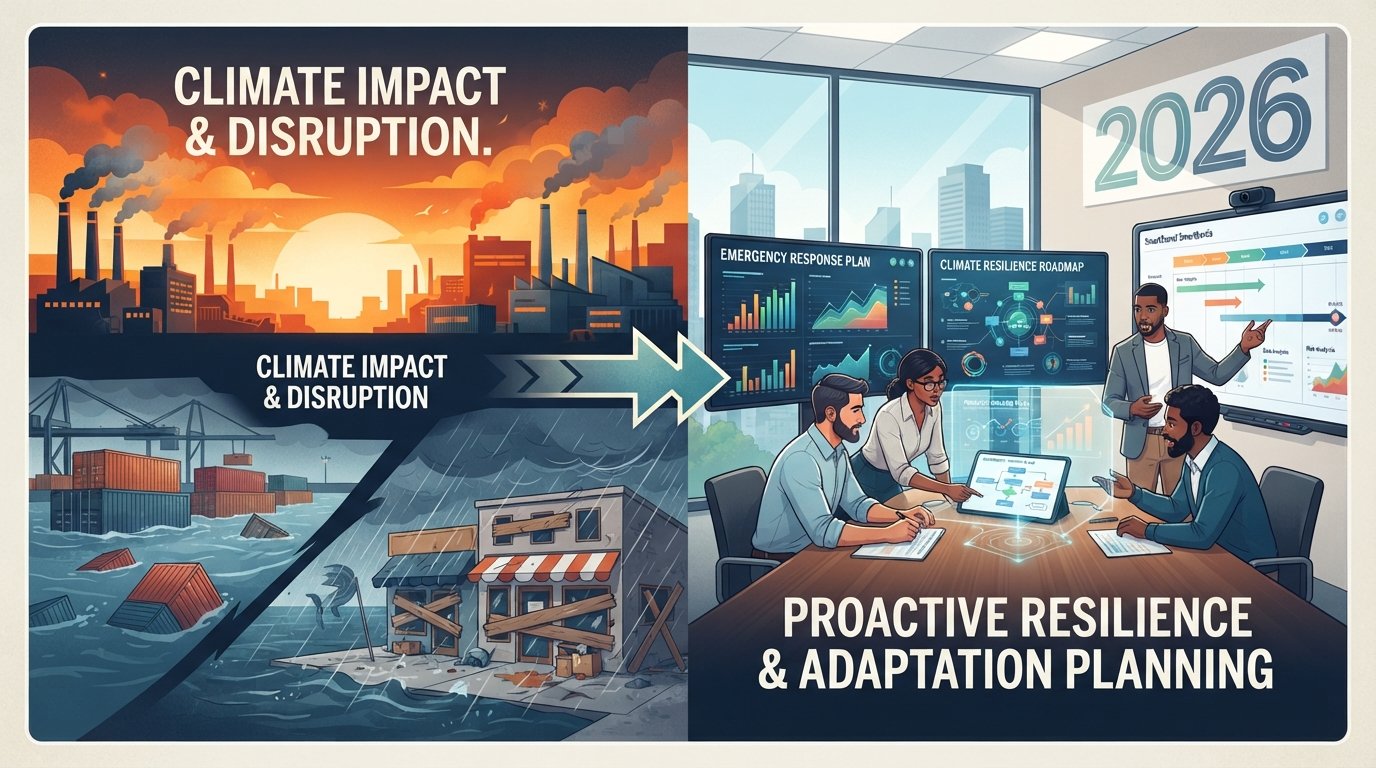
The world of business and industries are facing an unprecedented moment of accountability. We are not just witnessing seasonal shifts or irregularities in climate resulting in many disasters to occur, we are experiencing a fundamental transformation of the global operating environment.
In the first half of 2026 alone, natural disasters inflicted an estimated $100 billion in economic losses globally . As European summer heatwaves drove the temperature past 42 degrees Celsius, resulting in over 25,000 deaths and devastating industries from shipping to manufacturing, it became clear that climate change represents not merely a future risk but an immediate condition that is reshaping the international business landscape. Industries are innovating business continuity recovery strategies that entrepreneurs and industries are adopting to survive and thrive in the face of escalating climate risk.
Global Catastrophes : The Climate Disasters of 2026
The events happening in 2026 is a warning that is demonstrating the consequences of climate change on humans and their economic systems. The threats are varied and widespread, confirming the multiple types of climate risk that are now currently confronting us.
- Unprecedented European Heatwaves: Europe, the fastest-warming continent, endured five successive heatwaves, turning summer into a season of crisis . This is not just an environmental issue but a major economic one. In Germany, Greenpeace estimated the summer heat cost the economy at least €36 billion ($42 billion) through crop failures, health-related absenteeism, and lost productivity . For context, what natural disasters occur in Europe? Increasingly, the answer is crippling droughts and heatwaves that don’t leave behind “mountains of rubble” but cause immense economic damage . The heatwave also caused a record of low water levels on the Rhine and Danube rivers, disrupting transportation and forcing industrial giants like BASF and nuclear power plants to curtail production .
- Global Economic Toll: Throughout the world, the outcome is grim. Reinsurance giant Swiss Re:reported that total global economic losses from natural disasters hit $100 billion in H1 2026 . The costliest events included twin earthquakes in Venezuela and severe storms in the United States . This data helps us understand how climate change has affected the United States, where severe storms alone caused billions in damages . The disaster distribution is becoming more even across the globe, impacting both developed and developing economies.

The Entrepreneur’s Struggle: How Small Businesses Are Bearing the Brunt:
The media and headlines concentrate on large scale infrastructure and industrial losse, the actual human toll often begins with small businesses, which serves as the backbone of local economies. These businesses are suffering enormous and often irreversible damage from the physical risks of climate change.
- Operational Chaos for MSMEs: Micro level industries and domestic enterprises like (MSMEs) are particularly vulnerable. A report from WRI India indicated that 92% of surveyed MSMEs in India faced operational impacts due to heat stress, while 78% reported reduced worker productivity . Flooding is equally disrupting the transport, which resulted in delaying raw material supply, and harming inventory stock.
- The Actionability Gap: One of the most concerning facts is the actionability gap, acknowledge the risk, the majority depend on reactive, immediate tactics such as shifting stock, instead of investing in long term strategies. For instance, only 12% of MSMEs have adopted effective measures like cool roofs or insulation . Financial constraints are a significant obstacle, as merely 21% of MSMEs has access to emergency capital for addressing climate-related disruptions.
- Impact on the International Market: The small businesses bear the damage of climate disasters and send shockwaves through the international economy all over in the international market. MSMEs are crucial links in international supply chains. When they fail, it creates disturbances that spread outward, leading to delay and shortage of goods in the global marketplace.
Industrial Sector Under Siege: Countermeasures and Adaptation
The industrial sector, which functions as the engine of global production, is confronting severe and specific risks from climate change, as extreme weather impacts energy systems, supply chains, and worker productivity. This represents the damage encountered by the industries that drive our global economy.
The Impact on Industry
The damage faced by the industries extends far beyond flooded factories. Logistics and energy crises are exemplified by the drought induced low water levels in the Rhine River. This transportation for goods such as chemicals and steel forced cargo ships to reduce their load to just 20% of normal capacity. This situation directly undermined energy security by impairing coal and nuclear power plants that depend on water for cooling, thereby generating a regional energy crisis. Sector performance diverges markedly: the impacts are highly uneven across industries. Oxford Economics observed that sectors including agriculture and manufacturing experience sharp declines during climate shocks, whereas financial services and communications demonstrate greater resilience because they rely less on physical assets. This divergence is producing both winners and losers within the global economy.
Countermeasures Adopted by the Industries
To counter these escalating threats, industries are developing and deploying sophisticated adaptation strategies.Enterprises are shifting from broad risk evaluations to detailed modeling of physical risks at their individual sites.The global automaker’s approach to revamping supply chain contingencies represents a vital countermeasure. Business continuity recovery plans now incorporate mapping “beyond your own assets” to detect weaknesses in suppliers, utilities, and transport networks. This enables firms to avoid the “blind spot” of assuming everything outside their organization will keep functioning during a climate event .
Conclusion
The situation with the climate crisis that will occur in 2026 is an illustration of what future challenges the business world
The climate crisis of 2026 is a glimpse that will change the whole business world giving an unpredictable collapse in the economic system. With the annual losses in the $100 billions, the damage faced by the industries and the struggles of small businesses are clear indicators that the status quo is no longer viable. Those who will make it out will realize that being prepared for changes in climatic trends is not a waste of money and time. Businesses and corporations that invest in new methods of business continuity recovery and proper infrastructure secured from climate changes will profit by making a better world for everyone and laying the foundation for a stable global economy in the future.